Intramuscular Injection Technique: A Step-by-Step Beginner's Guide
Step-by-step intramuscular self-injection technique for adults. Site selection (deltoid, vastus lateralis, ventrogluteal), needle gauge and length, aspiration, Z-track, and what to do if it goes wrong.
Founder & Compliance Lead • Reviewed May 20, 2026
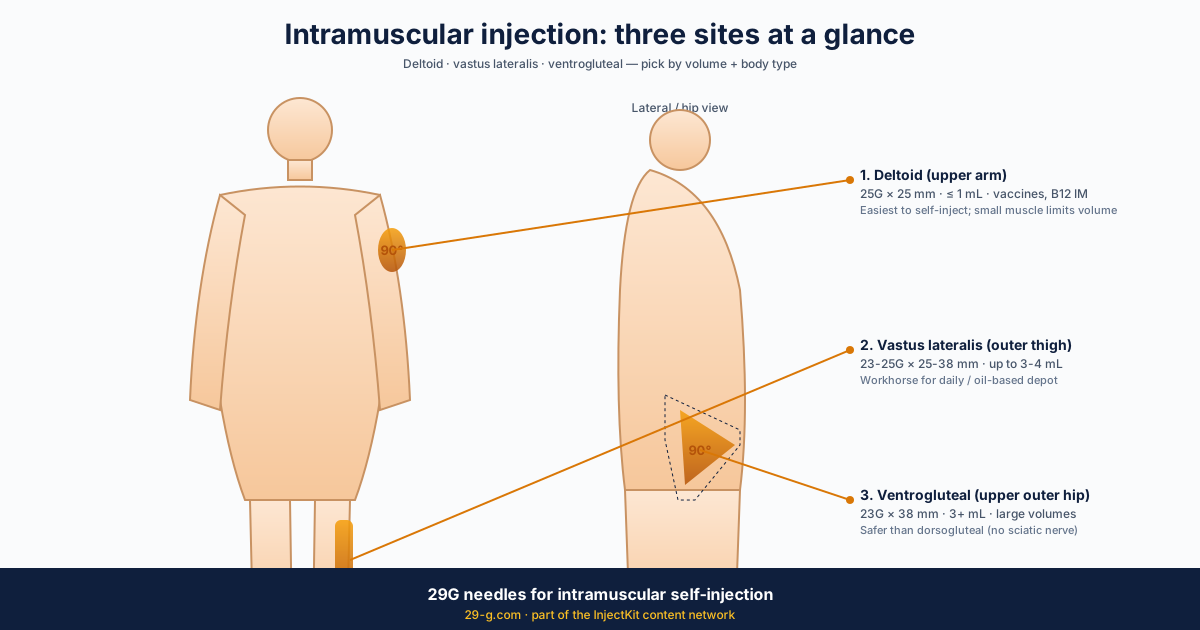
Intramuscular (IM) self-injection at home uses a 23G to 25G needle, 25 mm to 38 mm long depending on body fat, inserted at 90° to the skin into one of three accepted sites: deltoid (upper arm), vastus lateralis (outer thigh), or ventrogluteal (upper outer buttock). Pinch the muscle between thumb and fingers to lift it from the underlying bone, insert quickly to two-thirds of the needle length, aspirate if your protocol requires it, inject slowly over 10-15 seconds, withdraw straight out, apply gentle pressure with a dry gauze. Site rotation is non-negotiable.
Who this guide is for
You self-administer an IM medication at home — testosterone esters, B12 IM, vitamin D, allergy desensitisation, or another protocol — and you want the practical step-by-step that the leaflet doesn't quite spell out. This is the guide that names the things that go wrong on injection one, two, and three, and how to recognise that the needle is in the right depth without poking around blindly.
IM differs from subcutaneous (SC) injection in three key ways: the needle goes deeper, the gauge is wider (because IM solutions are often more viscous), and site selection is more anatomically specific because nerves and blood vessels matter when you're going 25-38 mm deep. The full subq technique companion lives on the 31-g blog.
Equipment for IM injection
| Item | Spec | Why |
|---|---|---|
| Syringe | 1, 2, or 3 mL Luer-Lock | Lock prevents needle detachment under pressure on thick solutions |
| Drawing needle | 18G or 21G × 38 mm | Thicker for fast vial draw; never inject with it |
| Injection needle | 23G–25G × 25–38 mm | 25 mm for lean adults / deltoid; 38 mm for ventrogluteal / heavier adults |
| Alcohol swabs | 70% isopropyl, single-use | Single use only; let dry fully before injection |
| Sharps bin | UK BS 7320 compliant | Yellow-lid bin from GP / clinic / pharmacy |
| Gauze or cotton pad | Dry, sterile | Pressure after withdrawal; never wet |
Two needles per injection is standard: the wide drawing needle pulls the medication from the vial without flexing the bevel, then you swap to the thinner injection needle before going into muscle. The same needle for draw and inject is a beginner mistake — drawing through a vial stopper blunts the tip, which then hurts more going in and is more likely to bend.
The three IM injection sites
Deltoid (upper arm)
The deltoid is the easiest IM site to reach yourself. Find the bony point of the shoulder (the acromion process), drop down three finger-widths, and inject into the centre of the deltoid muscle. The injection zone is a triangle: apex at the acromion, base running across the upper arm.
Best for:
- Small-volume injections (≤ 1 mL — vaccines, B12)
- Adults with reasonable deltoid mass; not appropriate for very thin or very heavy adults
- Right-handed people injecting the left deltoid (and vice versa)
Limitations:
- Smaller muscle limits volume. Large oil-based testosterone doses (≥ 2 mL) are usually delivered to the thigh or glute instead.
- Radial nerve runs along the back of the upper arm. Stay on the lateral (outer) side of the deltoid, not the posterior.
Vastus lateralis (outer thigh)
The vastus lateralis is the largest practical IM site for self-injection. Sit down, find the bony point of the hip (greater trochanter) and the kneecap, divide the distance into thirds. The middle third along the outer-front surface of the thigh is the injection zone.
Best for:
- Larger volumes (up to 3-4 mL with caution)
- Self-injection (no twisting required)
- Daily or near-daily IM users
- Children and infants (it's the standard paediatric IM site)
Limitations:
- Some scar tissue accumulates over months of repeated use; rotate sides and within the strip.
- Quadriceps soreness for 24-48 hours is normal after IM into vastus lateralis. Walking helps; sitting all day doesn't.
Ventrogluteal (upper outer hip)
The ventrogluteal site is the safest large-volume IM site and the one increasingly preferred over the older dorsogluteal (top of the buttock) site that older drug leaflets still describe.
To locate ventrogluteal: place the palm of your opposite hand on the bony point of the hip (greater trochanter), point the thumb toward the navel, spread the index finger up along the iliac crest. The injection zone is the triangle between your thumb and index finger.
Best for:
- Large volumes (3+ mL)
- Adults of any body composition
- Avoiding the sciatic nerve (which runs through the dorsogluteal site)
Limitations:
- Awkward to self-inject without a mirror; usually a second adult administers.
- Requires confidence in landmark-finding the first time. Practice with a marker pen before the first injection.
The older dorsogluteal site (upper-outer quadrant of the buttock) is still in some leaflets but no longer recommended for self-injection because of the sciatic nerve and superior gluteal artery risk. Use ventrogluteal instead.
Choosing needle gauge and length
The right needle for IM is a balance of three things: medication viscosity (oil > suspension > aqueous), site (deltoid is smaller, thigh and glute have more fat), and your build.
| Site + body type | Gauge | Length |
|---|---|---|
| Deltoid, lean adult | 25G | 25 mm |
| Deltoid, average adult | 23G | 25 mm |
| Vastus lateralis, average adult | 23G–25G | 25–38 mm |
| Vastus lateralis, larger adult | 23G | 38 mm |
| Ventrogluteal, average adult | 23G | 38 mm |
| Ventrogluteal, larger adult | 21G | 38 mm |
| Oil-based testosterone esters | 23G–25G | 25–38 mm |
| B12 cyanocobalamin IM | 25G | 25 mm |
The 29G needle is too thin for most IM injection — it's marketed for subq and would bend or flex against muscle resistance for anything but the lightest aqueous solutions. The exception is B12 cyanocobalamin which is thin enough to push through a 29G needle, but even there a 25G is more reliable.
For the gauge selection rationale across all scenarios, the 29G vs 30G vs 31G needle gauge guide covers the geometry.
Step-by-step technique
- Wash hands. Soap and water, 20 seconds.
- Assemble equipment. Open the syringe + drawing needle + injection needle + alcohol swab + gauze. Lay everything on a clean surface.
- Draw the medication. Attach the drawing needle (18G or 21G). Insert into the vial, pull back the plunger past the dose volume, then push to the exact dose. Remove from the vial.
- Swap to the injection needle. Hold the syringe upright, unscrew the drawing needle, screw on the injection needle. Don't touch either needle tip.
- Expel air. Tap the syringe to bring bubbles to the top. Push the plunger gently until a small drop appears at the needle tip. Some air remains in the hub — that's normal and harmless for IM (the trapped air pushes the last drop in, an old technique still used).
- Locate the site. Use the landmarks above. Mark with a pen for the first few times if you're not confident.
- Clean the skin. Alcohol swab in a single firm sweep. Let it dry fully — 15-20 seconds, longer than feels natural.
- Pinch and lift the muscle between thumb and fingers, separating it from underlying bone. Some protocols (especially viscous testosterone esters) call for a Z-track instead: pull the skin laterally about 2 cm before insertion, hold it there, inject, hold for 10 seconds after injection, then release. Z-track seals the channel and reduces leakage.
- Insert at 90° in a single quick motion. The needle should sink two-thirds to all the way to the hub. Hesitation at this step is why the first injection hurts most.
- Aspirate if your protocol requires it. Pull back gently on the plunger for 1-2 seconds. If you see blood swirl into the syringe, withdraw and replace the needle and start over at a slightly different spot. Modern NHS technique skips aspiration for vaccines because the recommended sites are aspiration-irrelevant (no large blood vessels at deltoid IM depth); for oil-based depot injections at thigh or glute, aspiration is still widely practised.
- Inject slowly. 10 seconds per millilitre is the rough target for oil-based solutions; aqueous can go faster (5 seconds per mL). Watch the plunger move; don't muscle it.
- Hold the needle in place for 10 seconds after the plunger bottoms out. Lets the depot settle and prevents tracking.
- Withdraw at the same 90° angle. Don't sweep sideways.
- Apply pressure with dry gauze. Don't rub. Hold for 30 seconds; longer if you're on blood thinners.
- Dispose of both needles. Drawing needle and injection needle both go straight into the sharps bin. Never recap. Never bend.
What can go wrong
Sharp electric pain during insertion that radiates down the arm or leg.
You've contacted a nerve. Withdraw immediately. The pain should ease quickly; if it persists more than a minute, contact the prescriber. Common at the deltoid if you insert too far back (radial nerve) or at the old dorsogluteal site (sciatic nerve, which is why ventrogluteal is preferred).
Blood in the syringe when you aspirate.
You've hit a small blood vessel. Withdraw, replace the needle, and try a spot 2 cm away. The medication should not be injected into a blood vessel — for oil-based depots this can cause cough, embolism risk, or systemic effects. For aqueous medications the risk is less but the principle holds.
The needle bends or won't fully insert.
The bevel has hit muscle resistance at an angle. Withdraw and replace the needle. Bent needles are never reused. The most common cause is insertion at less than 90° or with insufficient force.
A hard lump under the skin 24 hours later.
Could be a sterile abscess (oil-based depots can encapsulate if injected too shallow), a haematoma (small bleed), or muscle inflammation. Cold pack for 10 minutes 3-4 times a day for the first 48 hours; warm pack after that. Persistent, painful, growing lumps need medical evaluation — possibly an infected injection site.
Significant bleeding after withdrawal.
A few drops is normal. Continuous bleeding for more than 2-3 minutes is unusual. Apply firm pressure for 5 minutes; mention to the prescriber if you're on anticoagulants and this happens repeatedly.
You inject the wrong dose.
Stop. Don't try to "fix" it by adding more or making up the next dose. Call the prescriber or NHS 111 with the details. Most IM medications have a wide safety margin; the priority is documentation, not panic.
FAQ
Do I need to aspirate every IM injection?
It depends on the site and the medication. NHS vaccine guidance no longer requires aspiration for deltoid IM (no large vessels at that depth). Oil-based testosterone depot injection at thigh or glute, by contrast, is still commonly aspirated because the deeper insertion has a non-trivial risk of crossing a blood vessel. Follow the prescriber's protocol.
Why is the IM needle so much longer than the subq needle?
Because the medication needs to clear the subcutaneous fat layer and deposit into muscle. Subcutaneous fat at the deltoid averages 3-5 mm in lean adults but can be 15-25 mm at the thigh or glute in heavier adults. A 25 mm needle reaches muscle in most deltoid scenarios; 38 mm is the workhorse for thigh and ventrogluteal in average-and-larger adults.
Can I reuse the same needle for the next injection if it's only been used once?
No. Single-use sharps are single-use. The tip blunts after the first insertion (visible under magnification), the inner channel may have residue, and the sterility seal is broken. Reusing needles is the single biggest avoidable cause of injection-site infection in home injectors. Full reasoning in why reusing needles is never safe.
The vial has rubber-stopper dust visible inside after I draw. Is it safe to inject?
Tiny particles of the rubber stopper are common in repeated multi-dose vials and are not typically harmful, but the standard practice is to use a filter needle (18G with a 5-micron filter) for the draw step when this is visible. If the particles are large or you can see floating fragments, discard the vial and contact the supplier.
Do I need to warm an oil-based testosterone vial before injecting?
Yes. Cold oil is 3-5× more viscous than room-temperature oil, which means slower injection, more discomfort, and a higher chance of injection-site irritation. Warm the vial by holding it in a closed fist for 5-10 minutes, or in a cup of warm (not hot) water. Never microwave.
Can I use the same gauge needle for both deltoid and thigh IM?
Possible but not ideal. Deltoid usually wants 25G × 25 mm for comfort; thigh in larger adults wants 23G × 38 mm for adequate depth. Many home injectors keep both sizes on hand and pick by site.
Related reading
- Subcutaneous Injection Sites: Abdomen, Thigh, Upper Arm Explained — companion subq technique guide
- 29G, 30G, 31G: How to Actually Pick a Needle Gauge — gauge-selection deep dive
- Reusing Insulin Needles: Why It's Risky — sterility rationale
- Sharps Disposal at Home: UK & EU Guide — used-needle disposal
For the supplies: 29G IM syringes at InjectKit come in 10, 30, 50, and 100 packs and ship from Spain to the UK and EU.
Citations
- NHS, "How to give an intramuscular injection" — nhs.uk
- BNF, "Routes of administration: intramuscular" — bnf.org
- CDC, "Administration of vaccines: IM technique" — cdc.gov
- WHO, "Best practices for injection safety" — who.int
- Cocoman A, Murray J, "Intramuscular injections: a review of best practice for mental health nurses" — Journal of Psychiatric and Mental Health Nursing, on ventrogluteal preference over dorsogluteal
- MHRA, "Drug Safety Update on injection-site reactions" — gov.uk
Frequently asked questions
Do I need to aspirate every IM injection? +
It depends on the site and the medication. NHS vaccine guidance no longer requires aspiration for deltoid IM (no large vessels at that depth). Oil-based testosterone depot injection at thigh or glute, by contrast, is still commonly aspirated because the deeper insertion has a non-trivial risk of crossing a blood vessel. Follow the prescriber's protocol.
Why is the IM needle so much longer than the subq needle? +
Because the medication needs to clear the subcutaneous fat layer and deposit into muscle. Subcutaneous fat at the deltoid averages 3-5 mm in lean adults but can be 15-25 mm at the thigh or glute in heavier adults. A 25 mm needle reaches muscle in most deltoid scenarios; 38 mm is the workhorse for thigh and ventrogluteal in average-and-larger adults.
Can I reuse the same needle for the next injection if it's only been used once? +
No. Single-use sharps are single-use. The tip blunts after the first insertion (visible under magnification), the inner channel may have residue, and the sterility seal is broken. Reusing needles is the single biggest avoidable cause of injection-site infection in home injectors. Full reasoning in why reusing needles is never safe.
The vial has rubber-stopper dust visible inside after I draw. Is it safe to inject? +
Tiny particles of the rubber stopper are common in repeated multi-dose vials and are not typically harmful, but the standard practice is to use a filter needle (18G with a 5-micron filter) for the draw step when this is visible. If the particles are large or you can see floating fragments, discard the vial and contact the supplier.
Do I need to warm an oil-based testosterone vial before injecting? +
Yes. Cold oil is 3-5× more viscous than room-temperature oil, which means slower injection, more discomfort, and a higher chance of injection-site irritation. Warm the vial by holding it in a closed fist for 5-10 minutes, or in a cup of warm (not hot) water. Never microwave.
Can I use the same gauge needle for both deltoid and thigh IM? +
Possible but not ideal. Deltoid usually wants 25G × 25 mm for comfort; thigh in larger adults wants 23G × 38 mm for adequate depth. Many home injectors keep both sizes on hand and pick by site.
Get your supplies
CE-marked syringes and alcohol prep pads. Shipped from Spain across the EU and UK.